


New Leadership Role: When responsibility has no boundaries
Starting a new leadership position often means taking on tasks that were never yours to begin with. What actually helps: role clarity, RACI, and self-leadership.
Enikö Török
6/6/20263 min read
New job. Fresh energy. New possibilities.
And then: the first real week. The second. The first month. And slowly, a feeling that something isn't quite right.
What the job description said, and what reality looked like
One of my clients stepped into a new leadership position. The role sounded great. The job description too. But it didn't take long before she noticed: the description had gaps. Tasks appeared that were never mentioned. Responsibilities were unclear. And the pattern was always the same: if something wasn't sorted, it landed on her desk.
Makes sense, right? She's the leader. So it must be her responsibility.
That's what she thought. Until we looked at it together, closely.
What had actually happened
When we looked more carefully, we found two things:
First: her own leadership team was overwhelmed. Tasks were piling up, decisions weren't being made, things kept getting stuck. So she stepped in. Not because it was her job, but because her predecessor had always done it that way. The pattern was already there before she even started.
Second: many of the administrative tasks she was handling every day could easily have been delegated to her assistant. But she didn't delegate. Because it's faster if I just do it myself. Because then I know it's done right. Because it's simpler that way.
The result: a leader doing the work of three roles, wondering why she has no time, and slowly starting to question whether this position was the right fit after all.
What the brain has to do with it
Here's something I shared with her that I want to pass on to you too:
When role clarity is missing, the brain does what it does best: it takes control. The amygdala, the brain's survival centre, reads ambiguity as a threat. And the simplest response to a threat is to act yourself, decide yourself, handle it yourself. It feels like competence. In reality, it's stress management.
There's something even more fascinating at play: our brains are wired to recognise and copy patterns. We learn through observation, without being aware of it. She never consciously decided to take over her predecessor's workload. Her brain had simply stored the pattern: this is how leadership works here. And she carried it forward, without ever questioning it.
This is called implicit learning, and it happens without any conscious decision. Which means changing a pattern requires more than insight. It requires deliberate action, again and again.
A tool: RACI
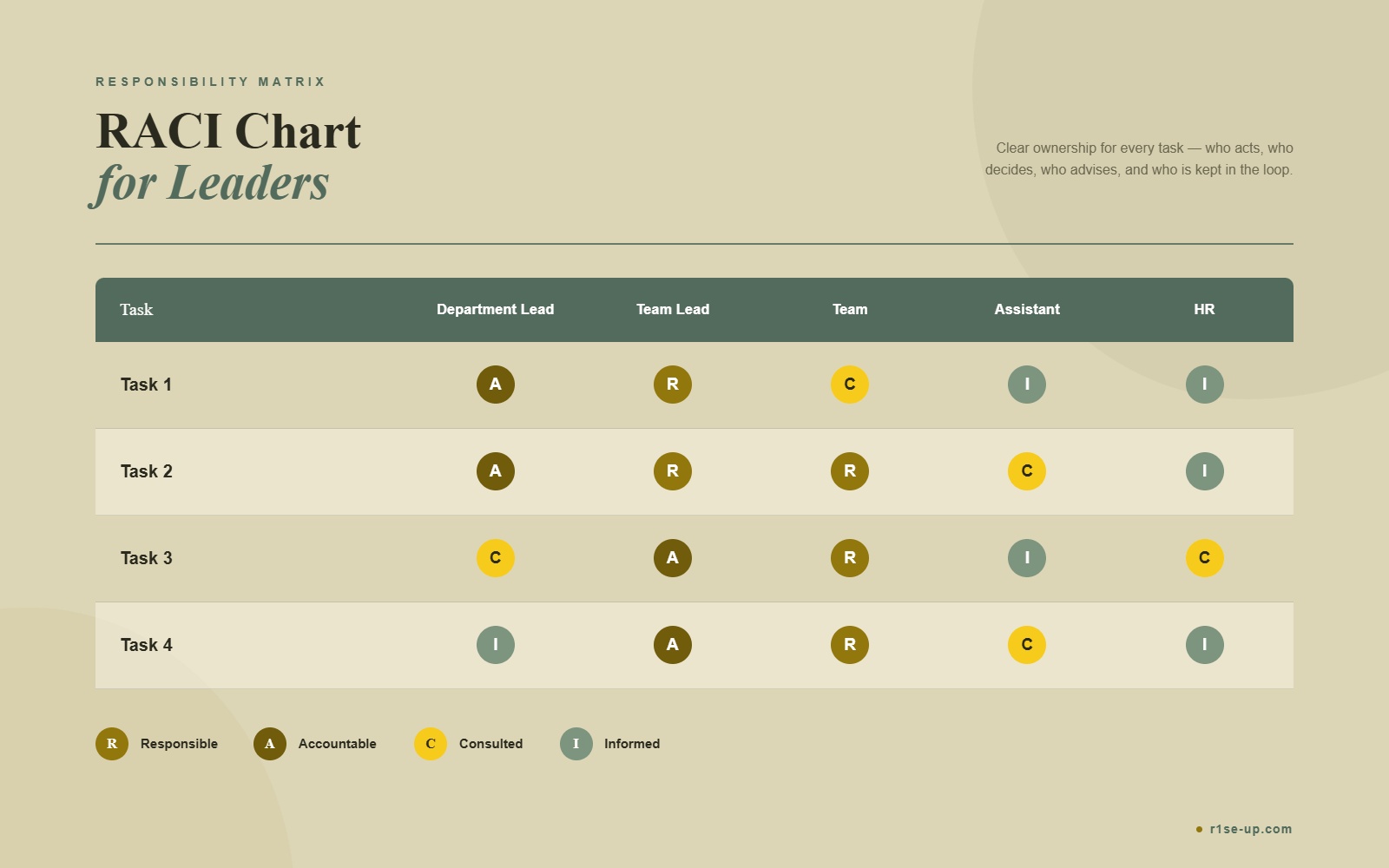
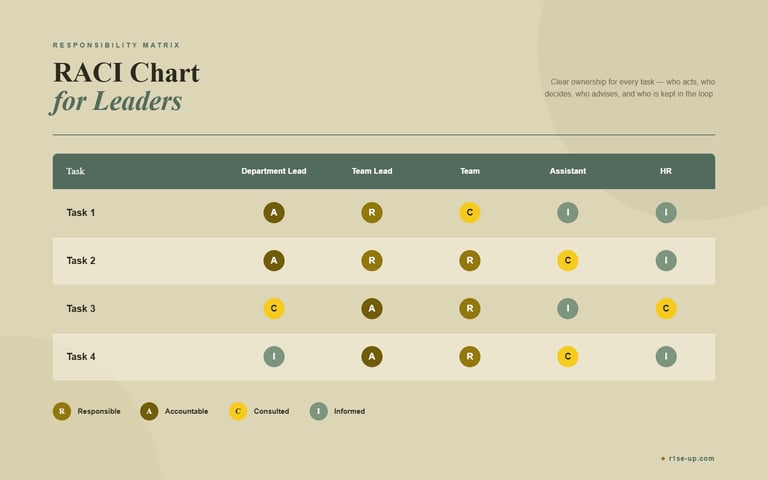
A RACI chart is a simple tool for clarifying roles. For every task, it answers four questions: Who is responsible for getting it done? Who is accountable for the outcome? Who needs to be consulted? Who needs to be kept informed?
For my client, it was a genuine moment of clarity. Seeing in black and white what was actually her responsibility, and what wasn't, helped lift the fog.
But a RACI chart alone doesn't solve the problem.
What's really going on underneath
The tool shows you what should be. Self-leadership shows you what actually is.
The most important thing I said to my client: she is a role model. Her leadership team watches how she acts, how she sets boundaries or doesn't, how she handles overwhelm, whether she delegates or quietly takes things on herself. And it learns. Unconsciously. Every day.
The question isn't just: what does your job description say? The question is: what pattern are you modelling?
If you don't set boundaries yourself, you'll lead a team that doesn't know how to either. If you take on tasks that aren't yours, others will stop owning their responsibilities. If you ignore your own limits, others will too.
That might sound harsh. But it isn't a criticism. It's biology.
And the first step out is always the same: look honestly. What are your values? How do they show up in your day-to-day? Or are you quietly crossing your own boundaries without even noticing?
A few questions to sit with
Which tasks are you currently carrying that were never really yours?
Where have you adopted a pattern without ever consciously choosing it?
What behaviour are you modelling that you wouldn't want to see in your team?
What would be the first small step toward setting a boundary you should have set a long time ago?
A space to explore this further
If you recognize yourself in this, you might not need more information but a different way of working with yourself.
Transformational Mentoring creates space for real awareness, integration, and change.